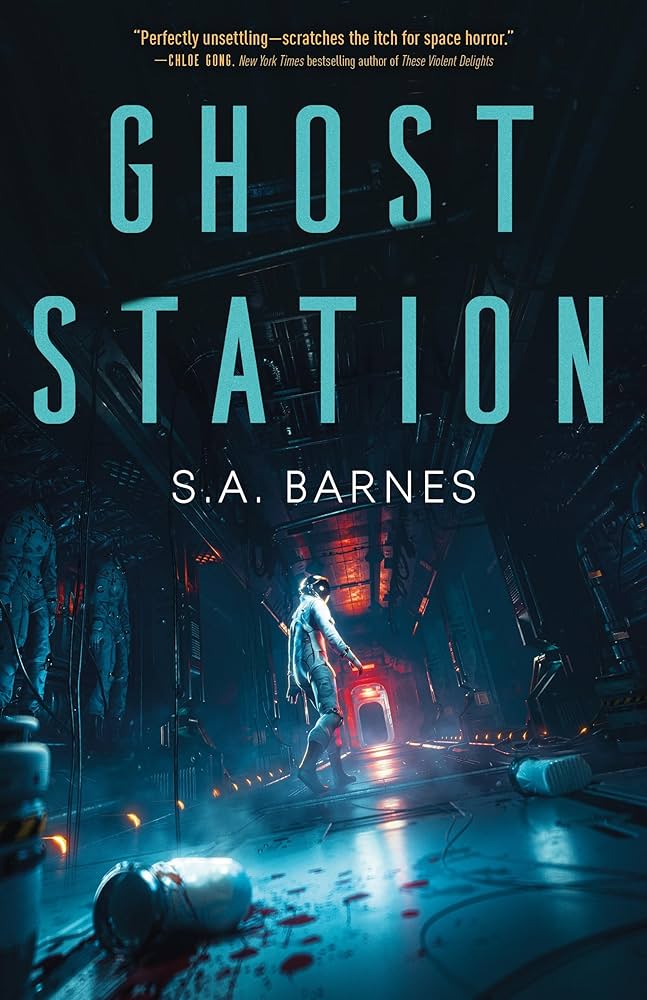
Psychologist Dr. Ophelia Bray, dedicated to studying and preventing Eckhart-Reiser syndrome (ERS) — a mental illness made infamous by a brutal mass murderer — joins a small exploration crew on an ancient, abandoned planet after the tragic death of a patient. When their pilot is found dead in what appears to be a gruesome murder, Ophelia fears a resurgence of ERS-induced violence. However, she suspects something even more sinister may be afoot. To survive, she and the crew must uncover the planet’s secrets and their own, but trust is scarce, and hidden dangers lurk.
Ghost Station, by S. A. Barns, is a light sci-fi horror, perfect for readers who like a creepy little mystery but still want to sleep at night.
Dr. Ophelia Bray is a profoundly insecure psychologist with a tendency to over-rationalize her own psychological hang-ups. She’s a bit too quick to assume malicious intent in just about everyone. Honestly, if my therapist had thoughts like hers, I’d be deeply concerned.
Though it’s light on the horror, I genuinely enjoyed the world-building in this book. From New Chicago to off-world space stations and a whole new planet, this book is rich with descriptive imagery. Although occasionally interrupted by impromptu history lessons, the vivid settings enhance the story’s immersion.
One of my favorite aspects of futuristic sci-fi is language evolution. I’m probably a total nerd, but it’s so fun! Living languages constantly evolve, and seeing how they change over time adds depth to world-building. Authors who overlook this miss out on creating a richer, more believable universe. S.A. Barnes doesn’t miss this opportunity, incorporating references to futuristic language like “digi-fotos” and “journo-streamers.”
The story’s pacing starts too fast, slows down significantly in the middle, and then picks up speed towards the end. At the novel’s beginning, I would have enjoyed more exploration of Ophelia’s interactions with her family and best friend, Julius, before she ventures into outer space. S.A. Barnes appears to waver between developing these relationships and diving straight into the action. Despite this uneven start, the narrative progresses quickly enough to keep me engaged. However, the ending felt somewhat rushed, which impacted the believability of the characters’ growth.
Ghost Station presents a classic “if only they’d trusted each other and communicated, literally none of this would have happened” scenario. A frustrating but all-too-real situation that’ll have you pulling your hair out as you shout, “No! Why would you do that?” at the pages.
Would I recommend this book?
Not for hardcore horror fans looking for their next great read. But if you’re a casual sci-fi reader looking for a quick weekend romp that will keep you entertained, this one’s a cutie.
Ghost Station is a quick, engaging read that balances light sci-fi with captivating world-building. Despite some pacing issues, it offers an intriguing mystery and a protagonist whose psychological complexities add depth—if not a bit of frustration—to the story.
Have you read Ghost Station? What did you think of Ophelia’s journey and the world-building? Share your thoughts in the comments below!
Stay tuned for more reviews and recommendations. Happy reading!
 J.M.
J.M. 
Leave a comment